

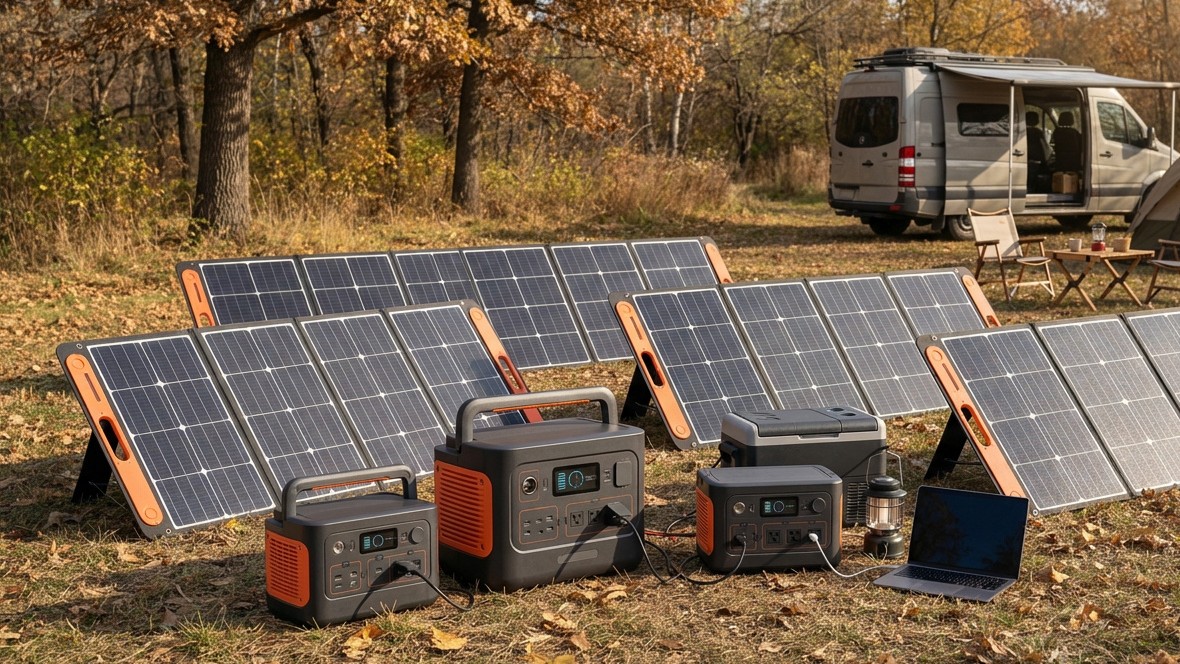
A portable power station on its own is a big battery: charge it at home, unplug it and run devices until it is empty. Pair it with a folding solar panel and it becomes a solar generator that refills itself during the day. That combination is what turns a gadget for the occasional camping trip into something you can rely on during a blackout, in a garden shed with no mains supply or on a week away from the grid.
The Black Friday sale running from 19 to 30 November puts three power stations and several panels on offer at the same time, which makes this a good moment to build a matched setup. Here is how the pieces fit together.
Step One: Pick the Power Station
Start with what you want to run and for how long. Capacity, measured in watt-hours, tells you how much energy is stored. Output, measured in watts, tells you how much you can draw at once.
C1000 Gen 2: The All-Rounder
The C1000 Gen 2 stores around one kilowatt-hour and delivers up to 2,000W across nine ports. Plugged into the wall, it recharges in about 49 minutes, so it is ready again quickly between trips. That is enough to run a fridge, laptops, lights and a kettle in short bursts, making this portable power station the most versatile size for weekends away and short power cuts.
C2000 Gen 2: Twice the Reserve
With 2,048Wh of capacity and 2,400W of output, peaking at 4,000W, the C2000 Gen 2 handles heavier appliances like power tools or an electric grill. It can be expanded to around 4kWh with an extra battery, which suits households planning for longer outages.
S2000: Home Backup Focus
The S2000 holds around 2kWh and is built to keep essentials running for up to 24 hours. If your main concern is keeping the router, fridge and a few lights on when the grid goes down, this is the one to look at.
Step Two: Match a Solar Panel
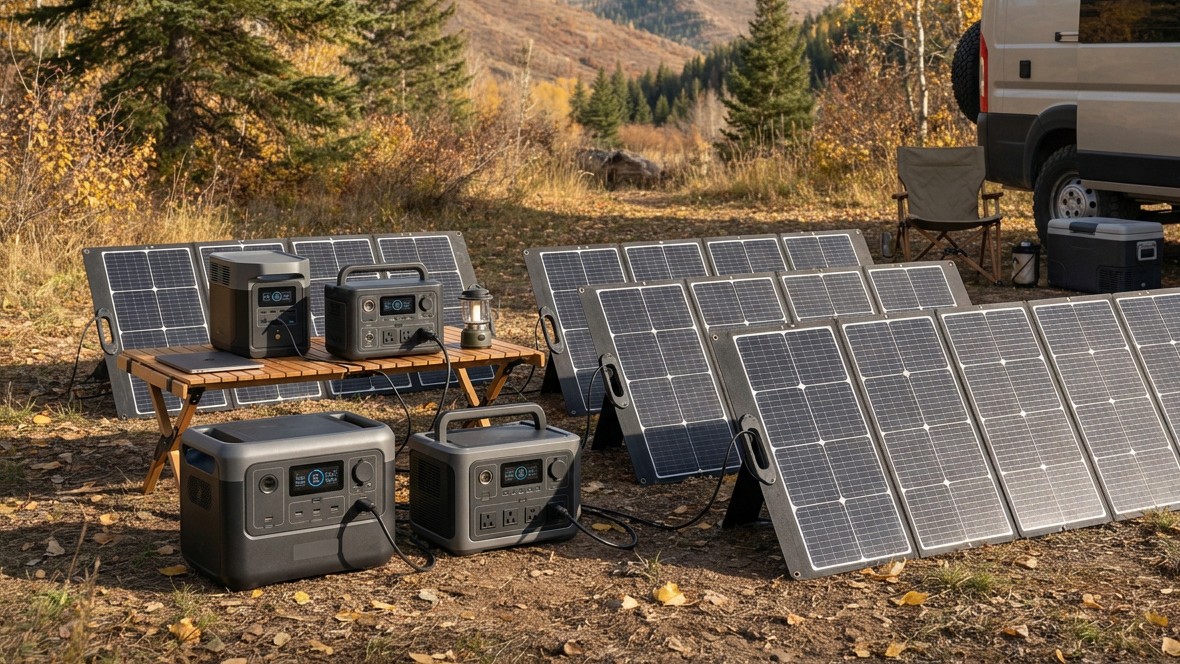
The panel decides how quickly the station refills when there is no socket nearby. A larger panel gathers more energy per hour of sunlight, while a smaller one is lighter to carry.
- PS200 Bifacial: Collects light on both sides, including light reflected from the ground. Best paired with the C2000 Gen 2 or S2000 where faster solar charging matters.
- PS100X: A mid-size folding panel that suits the C1000 Gen 2 for camping and garden use.
- 60W panel: Light and compact for topping up phones, lights and smaller stations on hikes or picnics.
A higher-wattage foldable solar panel pays off most on cloudy days, when every extra watt of capacity helps make up for weaker sunlight.
If you already own a panel from another trip, check its connector and voltage before buying a new one. Matching the station and portable solar panel from the same range avoids adapters and makes sure the station charges at its full solar input rate.
Step Three: Plan for Where You Will Use It
Blackouts at home: Choose capacity first. A C2000 Gen 2 or S2000 with the PS200 Bifacial keeps essentials going and recharges on the balcony or in the garden.
Garden sheds and allotments: A C1000 Gen 2 with the PS100X runs tools, a radio and lights without an extension cable across the lawn.
Trips and camping: Weight matters. The C1000 Gen 2 with the 60W or PS100X panel stays manageable to carry.
A Few Practical Tips
- Angle the panel toward the sun and adjust it every few hours for the best yield.
- Keep the station in the shade while the panel sits in the sun, as batteries prefer cooler temperatures.
- Charge the station fully before storing it, and top it up every few months.
Ready When the Lights Go Out
Anker SOLIX builds its power stations and folding panels to work together, so pairing a station with the right panel takes the guesswork out of planning. During the Black Friday sale, the C1000 Gen 2, C2000 Gen 2 and S2000 sit alongside the PS200 Bifacial, PS100X and 60W panels on the same promotion page. It is worth comparing the solar generator kit options there before the sale closes.
For more ideas on smart energy, travel kit and home tech, come back to BlogsBuddy anytime.